Since the Star Wars Episode IX trailer dropped last Friday, I have enjoyed the vast mixture of excitement, concern, apathy and cultural bemusement the internet generated in response. I share the general complaint that people who care about Star Wars have noted so far, that it appears director JJ Abrams intends to undo much of what Rian Johnson built up in The Last Jedi. Johnson introduced a vision of the Force that was more egalitarian and not something that belonged exclusively to the elite Skywalker bloodline. He also reconnected the series’ imagery and themes with the original roots of the Star Wars franchise, directly referencing Kurosawa films and Joseph Campbell. I anticipate that this new movie could be disappointing, both as a Star Wars fan and as a movie snob, but on the latter front perhaps there is a new hope.
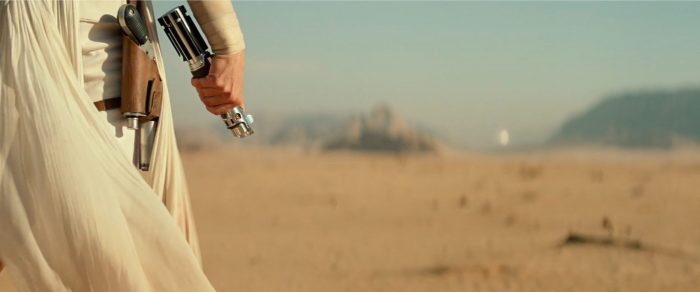
Upon re-watching the trailer again this morning I was struck by the first sequence that features a desert stand-off between Rey and a TIE fighter whose unseen pilot is almost certainly her nemesis and possible future boyfriend, Kylo Ren. What I noticed made me want to add to this conversation in a constructive way.
The most exciting aspect of The Last Jedi was Johnson’s erotic approach to the Force and the developing relationship between Rey and Kylo. Their mind-melds and physical encounters were characterized by symmetry, reciprocity, anticipation, submission, teamwork, compassion and great tension. Their images together featured phallic symbols, leather, moisture and sweat, touching, heavy exertion, and even nudity. The lightsaber as a shared tool of immense power goes without saying. . . they even have a pseudo-sex scene after the death of Snoke where they team up to shred a gang of red-plastic and leather plated BDSM bodyguards with kinky red knife-whips! If this trailer is any indication, it seems that Abrams noticed this aspect in The Last Jedi and actually intends to build upon the erotics of Episode VIII. To illustrate this possibility, I am going to describe the 13 shots that comprise this sequence in the trailer. Note, I am not going to include the Luke Skywalker voiceover featured in the trailer, as this is distracting and unlikely to be featured anywhere in the final film. Here goes:
Shot 1 – (14 Seconds) First we hear Rey’s heavy breathing before we open on a medium shot of Rey in a desert. It is likely that we are either on the planet Jakku (her childhood home world where her parents orphaned her) or Tatooine (her mentor Luke Skywalker’s childhood home world). She is visibly distressed and glistening in the heat, but begins to control her breathing as we zoom in to center on her face and then pan down to her tool belt as she un-holsters her lightsaber with her right hand and pulls it across her body, left to right. Rey is wearing what can only be described as a beige Jedi monk outfit.
Shot 2 – (4 seconds) Cut to behind Rey’s back for a master shot of the desert. Due to perspective, she is about as tall as any of the nearby mountains and is standing centered on the left third of the frame. The camera is at hip elevation and so the sky is the dominate element of the frame. A cloud is blocking this planets sun for the moment. A closer scan reveals a black ship, barely a dot on an iPhone screen, approaching in the right third of the frame, mirrored across the vertical axis from Rey’s lightsaber. This left-right pairing will be reinforced throughout this sequence.
Shot 3 – (4 seconds) A close-up from behind Rey’s right hip, lightsaber in hand pointed down at an angle. Rey takes up the left third of the frame now. The camera then rack focuses to the black ship in the distance, now brightly reflecting sunlight, which is approaching in the right third of the frame. We hear the looming siren of a TIE fighter’s iconic ion engine as the focus adjusts. Both the tip of Rey’s lightsaber and the approaching ship are again mirrored across the vertical axis of the frame, reinforcing the spatial relationship established in Shot 2. This familiar image evokes many a western stand-off and harkens way back to Star Wars’ western genre heritage. George Lucas originally envisioned the Jedi as space samurai, influenced by the Japanese samurai films of the 1960’s and ‘70’s. But, this is an instance of cultural cross-pollination, as Lucas was surely aware, because the cinematic grammar and warrior code ethos of Japanese samurai films were in part inspired by popular Golden Age Hollywood westerns. Though she isn’t using it, Rey has a blaster holstered on her right hip which further echoes the western theme.
Shot 4 – (3 seconds) A return to the set up at the end of Shot 1, though with Rey a bit to the left. The camera continues to inch forward and we can see she has composed herself and now looks focused on the confrontation in front of her.
Shot 5 – (14 seconds) After a title card, we get a fast-moving drone shot of the desert from a high elevation looking down. The drone quickly pans down and to the left, increasing with speed as the string section of the orchestra hums ominously. This is punctuated by a torrent of dust as a red & black TIE fighter screeches across the screen from right to left. Again, we have Rey on the left, out of frame, and Kylo approaching from the right. This shot, which at first seems to be of nothing is quietly radical! Like a brush stroke, or a lightsaber swipe, the drone camera is physically tracing the trajectory of the approaching showdown.
Shot 6 – (1 second) Same set up as Shot 3 as Rey activates her Blue lightsaber.
Shot 7 – (3 seconds) Camera is at hip level again for medium shot from a few feet behind Rey. Rey is again placed center left as she turns and kneels in a “runners’ mark” position. She is looking straight ahead past the camera as the ship is approaching in the background on the center right.
Shot 8 – (2 seconds) The most erotically charged shot, and the only glimpse of Kylo in this sequence. We see Kylo’s leather gloved hands tighten his steering wheel grip as he thrusts his handles forward, increasing velocity. The interior of the ship is black, grey, and cold in direct contrast to the warm colored sand and heat outside. Red monitors glow in the background adding the only color to the shot.
Shot 9 – (2 seconds) The camera is placed behind Rey’s back again which has us looking in the same direction as Kylo’s approach vector. She turns her head slowly around her left shoulder to glimpse the approaching ship one last time as the camera moves rapidly in for a close-up. The ion engine is now part of the orchestra.
Shot 10 – (1 second) Shot of Rey’s two feet in the sand this time on the right side of the frame as she begins to run from right to left away from Kylo.
Shot 11 – (4 seconds) Rey is running from right to left at full speed as Kylo flies in from the right. The camera is still at hip elevation and is tracking left but at an isometric angle that keeps both characters mirrored across the center-line of the frame, even as the distance between them closes. This is the first shot that has utilized an overtly non-planar angle (with the exception of a slight rotation featured in the drone shot). This shot also uses a wide-angle lens and you can notice the concave curve of the desert ground at the edges of the screen. This has the effect of reinforcing the looming collusion and increasing the gravitational pull of the center.
Shot 12 – (2 seconds) The camera is now placed in front of Rey sprinting at us. Rey is visually engulfed by the spiderweb window of the TIE Fighter cockpit and its four, pointed talons. Her head and the center window are now straddling the frame’s center point. Rey looks to be exerting tremendous effort just before she begins a jump.
Shot 13 – (3 seconds) A slow motion shot of Rey acrobatically twisting through the air as she attempts to vault over Kylo’s TIE Fighter. This final shot is at a more pronounced isometric wide-angle that combines the multiple planes of movement that were illustrated in the previous 12 shots. We fade to black just as Rey’s contortions and Kylo’s cockpit converge in the center of the frame.
The rest of the trailer looks more like standard Abrams. As a director, his greatest strengths are conception, laying the seeds for a series or franchise to grow, and well-paced kinetic action. You can feel the wind in some of the later trailer shots, as haphazard and unmemorable as they are out of context. But with Rey and Kylo, Abrams may be purposely adapting his style to signal a different, more nuanced and erotic grammar for the characters involved. In any action sequence, or movie franchise dependent on lightsaber battles, maintaining and developing consistent spatial relationships like those detailed above are often the only cues the audience gets for how to think about the characters on-screen. Here’s to hoping that that bores out in the final film.
 Partial Review