Mother

Is Mother the best non-Hitchcock Hitchcock film? ¹

*

I had been dying to revisit this one. As usual, director Bong Joon-ho is juggling a lot of balls at once while spinning a very taut yarn. One of the more subtler balls (concrete blocks?) in the air is his world building. It’s a unique skill of Bong’s that he exercises much more overtly in his science fiction & monster features, but one that is perhaps most successful here.

mothr1

Notice how many people in this nameless town roll their eyes when they see Mother enter the room; or how many young men determine the course and roadblocks for Mother’s vigilant(e) investigation; and how many of these young men she has known since they were children. Marginal town figures – drunks, homeless, ex-military conscripts, slimy lawyers, feebleminded school boys – populate the script, kept in check by unscrupulous cops, politician’s wives and big shot professors merely in town for the golf course.

Consider that Mother runs a shop selling medicinal herbs, roots, and fungi, in addition to unlicensed acupuncture. One of the opening shots is from Mother’s perspective looking out of her cavernous storefront, the walls overflowing with her dry and withered products, framing her adult son dancing with a dog on the street. Much later we hear an echo, a blood-curdling scream when a long-suppressed murder-suicide attempt is unearthed.

As much as this film is a portrait of Mother, it’s also a portrait of a town on the periphery of the modern. This is a society transformed by a future out of reach, dragged along with a past it’s trying to forget. A story where the real action has already happened and all we are seeing is the complicated aftermath. This is a film about the folks that were left behind.

Likewise, Bong’s film is akin to a peculiar and precarious chanterelle, decomposing and processing the runoff.

*

¹ Bong’s newest film Parasite should have US distribution this Fall. The film won the Palme d’Or at the 2019 Cannes Film Festival.

The Dark Knight

Christopher Nolan’s The Dark Knight is a challenging picture that still provokes one’s definitions of heroism and vigilantism more than a decade later. It depicts torture as a somewhat effective means of intelligence gathering. It depicts extraordinary rendition as helpful. It demonstrates secretive mass surveillance of citizen’s cell phones to be extremely effective and necessary under the right circumstances. It’s a film that presents the obstruction of justice for the murder of 5 cops as justifiable for social cohesion and a cleaner narrative. And it depicts a city government telling this lie to its citizens.

In case it wasn’t obvious then, or now, The Dark Knight is a parable for the United States’ vigilante role of sheriff of the liberal world order, with special emphasis on the Iraq War era. Nolan’s achievement is realizing the potential of a philosophical battle between Batman and Joker to server as an imperfect mirror to current events and a politically plural audience.

A few observations that stuck with me on this recent viewing:

  • The expansive mob network that effectively runs Gotham City is operating as a money laundering outfit for dark money emanating from mainland China via Mr. Lau’s company. The implication is that dirty money from China is directly empowering the rot in Gotham.
  • The reason Mr. Lau runs to Hong Kong is because China will not extradite one of its citizens to a foreign power under nearly any circumstances. That Nolan is including irregular international extradition law as a key plot challenge for Batman went way over my head when I first saw this.
    • A digression: This is the second Nolan Batman film where China and Chinese culture plays an elliptical role in the proceedings. In Batman Begins, Bruce Wayne is seen speaking Chinese after committing a robbery abroad, eventually finding himself in a prison in Bhutan. And notably, the terrorist organization Bruce briefly joins called the League of Shadows, headed by Ra’s al Ghul, is depicted as a vaguely Indo-Chinese faction by their fighting style, garb, set design and from the casting of the other members.
  • The final action sequence takes place in an under-construction building from which Joker is conducting his ferry-prisoners-dilemma spectacle and holding hospital patients hostage in clown mask disguises. That building was then under-construction Trump International Hotel and Tower in Chicago. . .

Erotics in The Rise of Skywalker trailer

Since the Star Wars Episode IX trailer dropped last Friday, I have enjoyed the vast mixture of excitement, concern, apathy and cultural bemusement the internet generated in response. I share the general complaint that people who care about Star Wars have noted so far, that it appears director JJ Abrams intends to undo much of what Rian Johnson built up in The Last Jedi. Johnson introduced a vision of the Force that was more egalitarian and not something that belonged exclusively to the elite Skywalker bloodline. He also reconnected the series’ imagery and themes with the original roots of the Star Wars franchise, directly referencing Kurosawa films and Joseph Campbell. I anticipate that this new movie could be disappointing, both as a Star Wars fan and as a movie snob, but on the latter front perhaps there is a new hope.
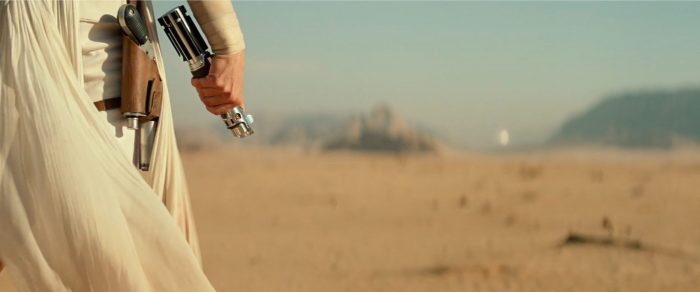
Upon re-watching the trailer again this morning I was struck by the first sequence that features a desert stand-off between Rey and a TIE fighter whose unseen pilot is almost certainly her nemesis and possible future boyfriend, Kylo Ren. What I noticed made me want to add to this conversation in a constructive way.

The most exciting aspect of The Last Jedi was Johnson’s erotic approach to the Force and the developing relationship between Rey and Kylo. Their mind-melds and physical encounters were characterized by symmetry, reciprocity, anticipation, submission, teamwork, compassion and great tension. Their images together featured phallic symbols, leather, moisture and sweat, touching, heavy exertion, and even nudity. The lightsaber as a shared tool of immense power goes without saying. . . they even have a pseudo-sex scene after the death of Snoke where they team up to shred a gang of red-plastic and leather plated BDSM bodyguards with kinky red knife-whips! If this trailer is any indication, it seems that Abrams noticed this aspect in The Last Jedi and actually intends to build upon the erotics of Episode VIII. To illustrate this possibility, I am going to describe the 13 shots that comprise this sequence in the trailer. Note, I am not going to include the Luke Skywalker voiceover featured in the trailer, as this is distracting and unlikely to be featured anywhere in the final film. Here goes:

Shot 1 – (14 Seconds) First we hear Rey’s heavy breathing before we open on a medium shot of Rey in a desert. It is likely that we are either on the planet Jakku (her childhood home world where her parents orphaned her) or Tatooine (her mentor Luke Skywalker’s childhood home world). She is visibly distressed and glistening in the heat, but begins to control her breathing as we zoom in to center on her face and then pan down to her tool belt as she un-holsters her lightsaber with her right hand and pulls it across her body, left to right. Rey is wearing what can only be described as a beige Jedi monk outfit.

Shot 2 – (4 seconds) Cut to behind Rey’s back for a master shot of the desert. Due to perspective, she is about as tall as any of the nearby mountains and is standing centered on the left third of the frame. The camera is at hip elevation and so the sky is the dominate element of the frame. A cloud is blocking this planets sun for the moment. A closer scan reveals a black ship, barely a dot on an iPhone screen, approaching in the right third of the frame, mirrored across the vertical axis from Rey’s lightsaber. This left-right pairing will be reinforced throughout this sequence.

Shot 3 – (4 seconds) A close-up from behind Rey’s right hip, lightsaber in hand pointed down at an angle. Rey takes up the left third of the frame now. The camera then rack focuses to the black ship in the distance, now brightly reflecting sunlight, which is approaching in the right third of the frame. We hear the looming siren of a TIE fighter’s iconic ion engine as the focus adjusts. Both the tip of Rey’s lightsaber and the approaching ship are again mirrored across the vertical axis of the frame, reinforcing the spatial relationship established in Shot 2. This familiar image evokes many a western stand-off and harkens way back to Star Wars’ western genre heritage. George Lucas originally envisioned the Jedi as space samurai, influenced by the Japanese samurai films of the 1960’s and ‘70’s. But, this is an instance of cultural cross-pollination, as Lucas was surely aware, because the cinematic grammar and warrior code ethos of Japanese samurai films were in part inspired by popular Golden Age Hollywood westerns. Though she isn’t using it, Rey has a blaster holstered on her right hip which further echoes the western theme.

Shot 4 – (3 seconds) A return to the set up at the end of Shot 1, though with Rey a bit to the left. The camera continues to inch forward and we can see she has composed herself and now looks focused on the confrontation in front of her.

Shot 5 – (14 seconds) After a title card, we get a fast-moving drone shot of the desert from a high elevation looking down. The drone quickly pans down and to the left, increasing with speed as the string section of the orchestra hums ominously. This is punctuated by a torrent of dust as a red & black TIE fighter screeches across the screen from right to left. Again, we have Rey on the left, out of frame, and Kylo approaching from the right. This shot, which at first seems to be of nothing is quietly radical! Like a brush stroke, or a lightsaber swipe, the drone camera is physically tracing the trajectory of the approaching showdown.

Shot 6 – (1 second) Same set up as Shot 3 as Rey activates her Blue lightsaber.

Shot 7 – (3 seconds) Camera is at hip level again for medium shot from a few feet behind Rey. Rey is again placed center left as she turns and kneels in a “runners’ mark” position. She is looking straight ahead past the camera as the ship is approaching in the background on the center right.

Shot 8 – (2 seconds) The most erotically charged shot, and the only glimpse of Kylo in this sequence. We see Kylo’s leather gloved hands tighten his steering wheel grip as he thrusts his handles forward, increasing velocity. The interior of the ship is black, grey, and cold in direct contrast to the warm colored sand and heat outside. Red monitors glow in the background adding the only color to the shot.

Shot 9 – (2 seconds) The camera is placed behind Rey’s back again which has us looking in the same direction as Kylo’s approach vector. She turns her head slowly around her left shoulder to glimpse the approaching ship one last time as the camera moves rapidly in for a close-up. The ion engine is now part of the orchestra.

Shot 10 – (1 second) Shot of Rey’s two feet in the sand this time on the right side of the frame as she begins to run from right to left away from Kylo.

Shot 11 – (4 seconds) Rey is running from right to left at full speed as Kylo flies in from the right. The camera is still at hip elevation and is tracking left but at an isometric angle that keeps both characters mirrored across the center-line of the frame, even as the distance between them closes. This is the first shot that has utilized an overtly non-planar angle (with the exception of a slight rotation featured in the drone shot). This shot also uses a wide-angle lens and you can notice the concave curve of the desert ground at the edges of the screen. This has the effect of reinforcing the looming collusion and increasing the gravitational pull of the center.

Shot 12 – (2 seconds) The camera is now placed in front of Rey sprinting at us. Rey is visually engulfed by the spiderweb window of the TIE Fighter cockpit and its four, pointed talons. Her head and the center window are now straddling the frame’s center point. Rey looks to be exerting tremendous effort just before she begins a jump.

Shot 13 – (3 seconds) A slow motion shot of Rey acrobatically twisting through the air as she attempts to vault over Kylo’s TIE Fighter. This final shot is at a more pronounced isometric wide-angle that combines the multiple planes of movement that were illustrated in the previous 12 shots. We fade to black just as Rey’s contortions and Kylo’s cockpit converge in the center of the frame.

The rest of the trailer looks more like standard Abrams. As a director, his greatest strengths are conception, laying the seeds for a series or franchise to grow, and well-paced kinetic action. You can feel the wind in some of the later trailer shots, as haphazard and unmemorable as they are out of context. But with Rey and Kylo, Abrams may be purposely adapting his style to signal a different, more nuanced and erotic grammar for the characters involved. In any action sequence, or movie franchise dependent on lightsaber battles, maintaining and developing consistent spatial relationships like those detailed above are often the only cues the audience gets for how to think about the characters on-screen. Here’s to hoping that that bores out in the final film.

What I’ve Been Watching

Capernaum – For this western viewer, this is an eye-opening and harrowing snapshot of what is going on in Beirut seen through the lens of a 12 year old boy named Zain (played by a Syrian refugee with a demonic zeal in his eyes) living and hustling on the streets. You see an environment that is festering with poverty and overcrowding, buffeted by desperate regional migration from Africa and Syria. The city, the state and the family unit as completely dysfunctional. The grimmest, funniest and best sequence is when Zain is basically raising an Ethiopian baby alone! and features Zain dragging his child, Jonas, around on a skateboard in a pot. . . My main critique is of the courtroom frame for the story, which gets a little too sappy for my taste. Director Nadine Labaki uses impressionistic cinematography and a frantic editing style to capture it all. She is someone to keep an eye on.

Happy Hour – This nearly 5 and a half hour film is an absolute delight. You follow four female friends in their 30’s, basically just exploring their friendships and personal relationships. Much of the film focuses on the mundane – family unit routines, jobs, commutes – until one of the friends reveals she cheated on her husband and is now filing for divorce. Things set off from there though nothing is ever that dramatic or boils over, it’s almost anti-Hollywood; nonetheless, it builds and builds into something dynamic, complex and alive. Director Ryusuke Hamaguchi has a penchant for holding on the smallest details for as long as possible, surprising you later as the meaning sinks in. Scenes are rarely less than 10 minutes and frequently much longer. His digital cinematography was inspiring too, it has that HD soap opera look, but over time i found it got me much closer to the characters. Again, it felt more real. For example, he plays a lot with contrast, opting to shoot characters in front of bright windows, knowing you won’t be able to see the actor. He’s also quite restless with his editing and framing. A picnic scene with the 4 women will feature 6-8+ different angles and he’s constantly switching between them. I cannot wait to see Hamaguchi’s latest, Asako I & II.

Destroyer – Seedy, opioid fueled LA neo-noir. Nicole Kidman is disturbing and hideous, a make-up feat I thought impossible. Similar to Aaron Katz’s Gemini, this one can’t compete with the best LA noirs this century (Mulholland, Dr., Drive, Brick, Inherent Vice, BR2049) but still manages to carve out its own little space. Director Karyn Kusama favors marginal genre tweaking here, reminded me a lot of Soderbergh’s genre exercises.

Week in Review: May 14th – 20th, 2018

Claire’s Camera – Even Hong Sang-soo’s experiemental, slapdash editing ruse is more interesting and more fun than most film efforts, a testament to his talent. Here he’s gathered regular Kim Min-hee and French titan Isabelle Huppert to make a low stakes, 70 minute love triangle drama, shot on the streets of Cannes while the three of them were attending the eponymous film festival a few years ago. The film is a sort of artist’s statement (though its difficult to know when Hong is sincere. . .) about Hong’s approach to editing and the act of capturing someone on camera. Claire (Huppert) takes Polaroid pictures of characters throughout claiming that when you take a photo of someone, the person is changed. To look at that photo is to look at the distance between what you have changed into and what you were. Thus, filmmaking is the act of capturing change. Making all of this more complicated is the non-linear editing. Frequently the film jumps backwards and forwards in time, testing the viewer to not only compile the timeline but to focus on how the characters are imperceptibly changing.

Racer and the Jailbird – Belgium director Michaël R. Roskam newest, starring the beautiful Adèle Exarchopoulos and the beautiful Matthias Schoenaerts. I haven’t seen Roskam’s much lauded Bullhead and this film doesn’t whet the appetite. To start, Racer features a bizarre narrative with no less than three jarring plot shifts that actually change what the film is about. Most viewers having seen the first 30 minutes will not be expecting this film to have more to say about terminal illness and reform-based justice systems than bank robbing or racecar driving. Even more confusing, the movie was marketed as a sexy, Euro-crime thriller. At the very least its a surprising ride featuring two genuine francophone stars in their prime, I’m just skeptical that there is much of anything going on under the hood; a strange injection of Americana, sentimentality and Christianity in the final moments left me scratching my head.

The Bitter Tears of Petra von Kant – I saw this Cuban production at the Kennedy Center in Spanish with a very poor translation. Thus, any nuance this performance contained was lost on me. It did make me want to see the Rainer Werner Fassbender film on which it is based. The story is about a lesbian love triangle in West Germany and focuses on the changing power dynamics in a liberalizing Europe. This rendition maintains the location and time period of the film, but utilizes 4 male actors in drag for the lead roles. For an informed review from someone who did not need the subtitles I recommend this: PLACEHOLDER.

My Next Guest Needs No Introduction – Tina Fey is an important and hilarious comic, and this interview is an excellent introductory biography of her. She seems to be truly struggling with how to navigate our ever more politically correct world and the toxic culture of social media. I will talk about this a bit below, but I would like to see her stay away from SNL.

John Mulaney: Kid Gorgeous at Radio City – As a fan of John Mulaney, I was happy to see him provide a mostly entertaining special that, if venue size is any indication, epitomizes his well-earned popularity. I was also surprised by the size of his ambition, as this special is a claim to the comedy throne left vacant by #MeToo. But in lieu of this, I was left a bit sad. When comics go bigger, its inevitable that they will also have to be broader. This is a pop culture law of physics. In this special, Mulaney is louder, nastier, more machismo than normal, and though these are necessary land grabs for a broader comedy identity, I found I was laughing much less. Mulaney in conversations, interviews, working behind the scenes, and in smaller productions is weirder, brainier and riskier, traits that have gotten him this far. I hope he finds ways to maintain those characteristics as his star continues to rise.

Saturday Night Live – I was so high off of the Sterling K. Brown episode that I ended up watching the rest of this season. I would liken it to watching a clown car drive up off a ramp placed at the edge of a cliff and then continuing to watch as the clowns plunge into gorge, exploding on impact. That is to say, it started funny, and then quickly became very not funny and sort of painful. Witnessing Tina Fey host this finale was the final gut punch. She’s so talented and the years where she was head writer on SNL are some of the very best in the show’s history. Unfortunately, the skits they wrote for her were either overly reliant on that legacy, presenting old favorites devoid of their necessary cultural context, or dead on arrival political commentaries that have typified this season. My advice for Tina, follow the wise Kylo Ren’s advice and, “let the past die. Kill it, if you have to. That’s the only way to become what you were meant to be.”

Tully – Jason Reitman, Diablo Cody, and Charlize Theron have teamed up again for possibly their weirdest film yet. I was excited for this one, as Young Adult, their previous collaboration is probably Reitman’s best film. Tully is an om to the maternal experience and a fairly interesting indictment of new age lifestyles. I don’t think this movie works in the end, nor have I thought much about it since, but I enjoyed myself thoroughly despite its flaws. Cody is just a fun writer (I recommend seeing Jennifer’s Body for her finest work) and Theron can make any material compelling.

Michael Che Matters – Surprisingly funny. More people should be talking about this. Che is actually offensive in this special and seems sincere about it, repeatedly building a tension with his audience that his jokes then release. The fun is seeing how long he can sustain the awkwardness before he lets the audience off the hook. It goes without saying, but this guy is going places.